
Seeking Freedom From Hellfire
During the final ten days of Ramadan, Muslims focus on seeking freedom from Hellfire. The Ramadan Space offers a variety of interactive elements designed to help elevate your spiritual knowledge throughout this blessed month.
Itikaf
وَاِذۡ جَعَلۡنَا الۡبَیۡتَ مَثَابَۃً لِّلنَّاسِ وَاَمۡنًا ؕ وَاتَّخِذُوۡا مِنۡ مَّقَامِ اِبۡرٰہٖمَ مُصَلًّی ؕ وَعَہِدۡنَاۤ اِلٰۤی اِبۡرٰہٖمَ وَاِسۡمٰعِیۡلَ اَنۡ طَہِّرَا بَیۡتِیَ لِلطَّآئِفِیۡنَ وَالۡعٰکِفِیۡنَ وَالرُّکَّعِ السُّجُوۡدِ ﴿۱۲۶﴾
“And remember the time when We made the House a resort for mankind and a place of security; and take ye the station of Abraham as a place of Prayer. And We commanded Abraham and Ishmael, saying, ‘Purify My House for those who perform the circuit and those who remain therein for devotion and those who bow down and fall prostrate in Prayer.’” (Surah Al-Baqarah, Ch.2: V.126)
Click each tile to find out more about Itikaf
Meaning behind Itikaf
Part 1
Itikaf means to stay in one place
Meaning behind Itikaf
Part 2
Restrain Oneself
Meaning behind Itikaf
Part 3
Remain in one place for the purpose of devotion
When and Where to Sit Itikaf
Part 1
In the last ten days of the month of Ramazan (Sahih al Bukhari, Kitab al-i‘tikaf, Hadith 2044)
When and Where to Sit Itikaf
Part 2
Start after Fajr Prayer on the 20th Ramazan (Jami` at-Tirmidhi, Kitab al Soum an Rasulullahsa, 791)
When and Where to Sit Itikaf
Part 3
Itikaf can only be performed in a congregational mosque (Jame Masjid) [Sunan Abi Daud, Kitab al-Siyam, Bab al-mu‘takifi ya‘ood-ul-mareeda]
What are some of the sunnah for those who sits Itikaf
Point 1
You cannot sit Itikaf without fasting
Point 2
You cannot attend a funeral
Point 3
You cannot touch your wife or have conjugal relationships with her
Point 4
You cannot go out of the mosque for anything except for the most necessary reasons that cannot be avoided. [Sunan Abi Daud, Kitab al-Siyam, Bab al-mu‘takifi ya‘ood-ul-mareeda]
Lailatul Qadr (The Night of Destiny)
اِنَّاۤ اَنۡزَلۡنٰہُ فِیۡ لَیۡلَۃِ الۡقَدۡرِ ۚ﴿ۖ۲﴾
“Surely, We sent it down on the Night of Destiny. ” (Surah Al-Qadr, Ch.97: V.2)
Three virtues of Lailatul Qadr (the night of destiny)


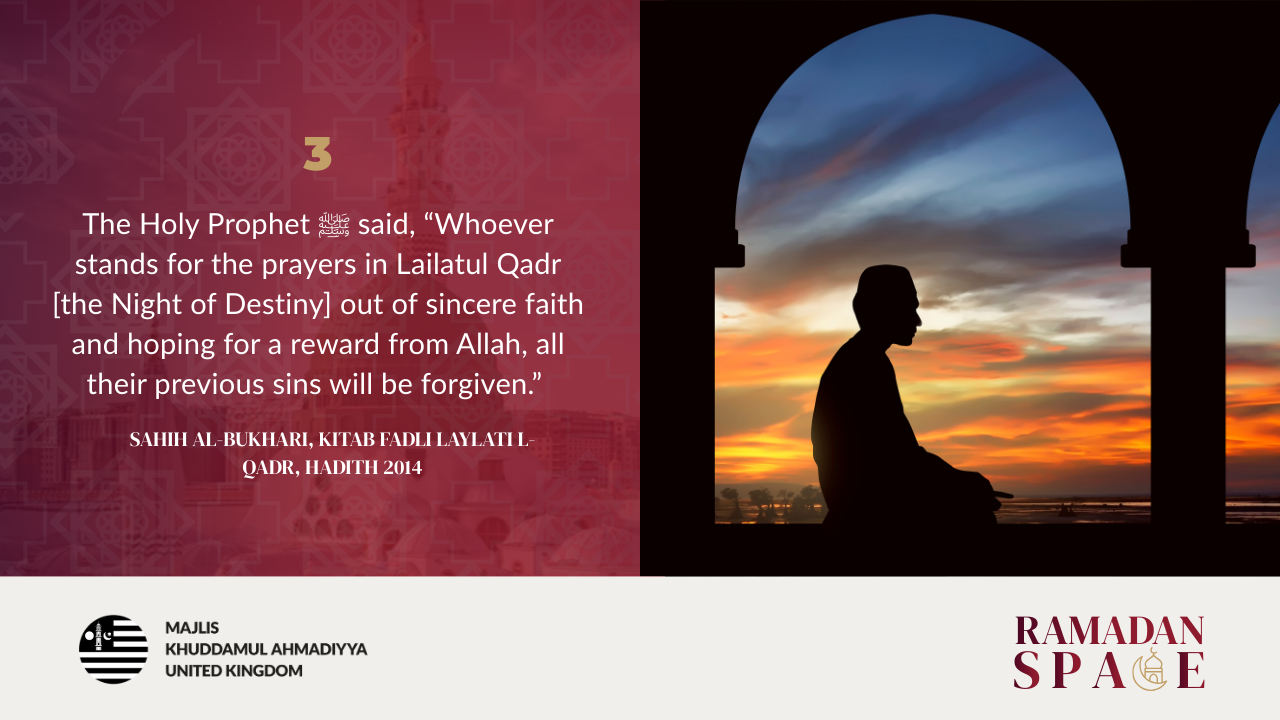
Three Prayers Related To Third Ashra of Ramadan
If One is to Experience Lailatul Qadr
The Holy Prophetsa taught the following prayer to be recited if one were to experience Lailatul Qadr:
اللّٰهُمَ إِنّكَ عَفُوّ تُحِبّ الْعَفْوَ فَاعْفُ عَنِّي
“O Allah, You are the Most Forgiving, You love forgiveness, so forgive me.” (Sunan Ibn Majah, Kitab ad-du‘a, Hadith 3850)
Praying For Salvation From Hellfire
As the last Ashra is salvation from the fire of Hell the Holy Prophet (sa) used to pray this prayer:
اللّٰهُمَ أجرني من النّار
“O Allah, protect me from the hell-fire.” (Sunan Ibn Dawud, Kitab al-adab)
Seeking goodness in this world
‘Our Lord, grant us good in this world as well as good in the world to come, and protect us from the torment of the Fire.’ (2:202)
Seven Steps To Attain Forgiveness
وَالَّذِیۡنَ جَاہَدُوۡا فِیۡنَا لَنَہۡدِیَنَّہُمۡ سُبُلَنَا ؕ وَاِنَّ اللّٰہَ لَمَعَ الۡمُحۡسِنِیۡنَ ﴿٪۷۰﴾
“And as for those who strive in Our path — We will surely guide them in Our ways. And verily Allah is with those who do good.” (Surah Al-`Ankabut, Ch.29: V.70)
Taken from Irfan-e-Ilahi
(Hazrat Mirza Bashiruddin Mahmud Ahmad – Khalifatul Masih II (rta) – Read More)
1
Regret
“He remembers his past sins and brings them before his memory, regretting them so immensely as to leave him akin to sweating profusely.”
2
Past Responsibilities
“one fulfills and completes all past responsibilities, which he is able to. Take, for example, one who was not performing his prayers in the past. If he decides to repent and it is the time for prayer, then he should perform his prayers. Or if a person possessing wealth has not performed Hajj, then he should perform Hajj. If he has not given Zakat, then let him overlook his past life; he should give it for this year.”
3
Remove all previous sins
“He removes all those sins that he is able to remove. For example, if one steals a buffalo and ties it to his own property, then he should return it and not keep it to himself.”
4
Seek forgiveness from the one you wronged – make amends
“One should, if possible, seek pardon from those whom he has pained and harmed.”
5
Right your wrongs
“Show benevolence to those people he has harmed; and if he can do nothing, then he should at least pray”
6
Resolve to never commit sin again
“He vows in his heart never to commit sin and make a deep-seated resolve that he shall no longer do so.”
7
Incline your soul towards virtue
“One begins to incline his soul toward virtue and that he strives to inculcate sincere thoughts and actions in his heart. Additionally, he should prepare his soul towards committing virtue.”
Three Ways to Spend a Purposeful Eid
1. Recite Takbeerat from the of Eid until Eid prayer starts
2. Pray tahajjud at the night of Eid
(Ibn Maja, Kitab us Sayam, Hadith no 1782)
3. Include poor people in your joy by contributing towards KeK schemes
You contribute by donating on MKA Chanda Portal and Check out Kek Schemes here.